

Books

Make More of Beginnings: Falling in Love

As writers, we’re so often told that the beginning of our story is make or break. It’s what we show our critique groups, our workshops, and agents when we query. It’s the first thing that readers see; it’s the first chance that they have to fall in love.

I want to look at this idea of falling in love with a story literally. Structurally. Because if it’s true that we fall in love with stories, that can tell us a lot about how to make our beginnings work.

ML-00046r.jpg

The other night, I was watching the movie Music and Lyrics. As the two characters in this romcom got to know each other, they revealed little bits of their personalities and their pasts, leaving larger questions open. There were little mysteries, patterns, things that we knew would resurface. (Her current employment as a plant waterer had to have a backstory—right? He was definitely going to do the cute eighties dance move again—right?) These two wanted to know more about each other. They had to see each other again, to find out what happens next. Every time the characters talked to each other, they were building a relationship, and even within the neat timeline of a romcom, they couldn’t do it all at once. They were leading each other forward, step by step. That’s not just how we fall in love with each other. That’s how we fall into a fictional world.

At the beginning of a story, a writer can’t unload everything on the reader all at once. That results in dreaded info dumps. Instead of thinking of the beginning as the place where you have to makeeverythinghappenrightnow, try thinking of it as a first date. I think there are two elements of a successful first date that mirror the balance that we strive for in a story opening.

First—there’s what you put in to your beginning. That’s like the first date itself. The events (plot), the chemistry of the people involved (characters), the conversation, (voice), the physical attraction (maybe that’s about genre, or premise—I don’t know, but I could do this extended metaphor thing all day!)

How do we make the all-important decision of what to put in, though? This is where the individual story comes in, as well as writing style and taste. Often when we hear the “rules” of how you’re supposed to start a story, they feel flat, prescriptive. Imagine if you tried to follow the steps in a first date manual in order to find true love. The process has to be organic and personal—it’s about what you and your story bring to the table that no one else can. Focus on what makes your story unique. I’ve heard a hundred times never to start with a long description of setting in kidlit—and then there the opening of Tuck Everlasting. We’re often warned to get straight to the story, but there are so many great books that start with character-focused monologues. Anything can work—if it’s what makes your story special, what pulls the reader in and leaves them enchanted, delighted, a little bit in love.

And then there’s the second element of the date, which is a little more intangible. It’s what you’re leaving out. The more I read, the more I’m convinced that we are sucked into stories by little mysteries. This is the not the mystery genre I’m talking about—I mean any question that the narrative plants in our minds. The same is true with people. After the first date, we might like what we know—but we have to want to know more!

Recently, I read an interview with the YA author Laini Taylor, author of the Daughter of Smoke and Bone series. She admitted that when she started out writing about her main character, she knew that Karou had blue hair and hamsas on her hands, but she didn’t know why. She was writing to find out what happened next. The beginning was about what Taylor didn’t know—and now those same questions pull readers into her story in huge numbers. (And yes, get them to fall in love!)
Make Your Prose “Pacey”: How to Engage with Expectation, Silence, and Surprise

“The prose needs better pacing, better rhythm” How do you begin to solve that kind of intangible issue? If chunks of your prose feel dull or plodding, consider Ze Frank’s words about the “rhythmic trinity.” Ze Frank is not a writer, but he is an endlessly creative maker and humorist. His groundbreaking 2006 vlog “The Show” profoundly influenced current mega-hit vloggers like John and Hank Green. In Ze’s 3:23 video about “the rhythmic trinity of expectation, silence, and surprise,” he talks about how that trinity helped his music–and how it applies to humor in the classic joke’s setup, pause, and punchline:

“Watching younger comics, you can learn a lot by seeing what’s broken. They might be good at building expectation and delivering surprise, but they haven’t figured out silence yet, and they blast through their lines so fast you don’t have room to laugh. Or they’re all surprise and pauses without building any patterns for the audience to relax into. When it’s all surprise, it stops being a surprise. The craft of it is in the matter of all three: expectation, silence, surprise.” 

Writers use expectation, silence, and surprise to create rhythm on both the micro, sentence-to-sentence level and the macro, story level. I’ll save story for a later blog. Right now, I’ll talk about how the rhythmic trinity works on the ground, in your actual prose.


Expectation: Ze says that creating expectation means building patterns for the audience to relax into. So that might mean

  • A stretch of quick-paced dialogue popping along
  • A series of sentences of similar length, which can create a nice train-wheel rhythm
  • A series of short action paragraphs
  • A series of brief descriptive passages that take us (for example) from the exterior of the house to the interior
  • Any of these creates a certain expectation, one you can then have fun disrupting.

Silence:

  • Slow down prose with a lingering descriptive passage,
  • Give any moment more air and breath by using a longer sentence, especially one that follows a series of short, brisk sentences of roughly the same length.
  • Insert a sudden break into the dialogue, in which one person literally falls silent

Surprise: 

  • Sometimes breaking a short sentence out in its own own paragraph makes it more arresting
  • Zoom in on a tiny physical detail—or zoom out suddenly to a bird’s eye view of your scene
  • Insert a bit of new information that turns the scene on its head 

How It Might Work (A Brief, Highly Simplified, and Pedestrian Example)

He said, “I tried.”

I said, “Not hard enough.”

He said, “But I can’t try harder.”

I said, “Well, you you have to.”

He said, “You’re asking too much.”

I said, “I’m asking for what you promised.”

[So now we’ve set up the expectations.]

And then, without warning, as if something had just occurred to him, or as if he’d had a sudden and interesting idea, he frowned and glanced up at the ceiling.  for a moment, his eyes rolled up even higher, till I could see their whites. [that string of clauses functioned as a kind of silence or hesitation] 

Then he fell face down on the table, quite dead.

[there’s the surprise element, made more surprising by the new paragraph]

More on using the rhythmic trinity on big story issues in my next blog. Meanwhile, I’d love to hear more ways you play with rhythm and pacing in your sentences.


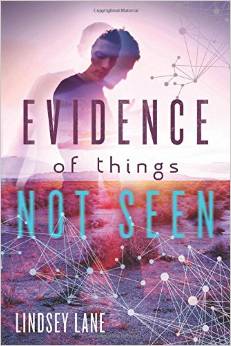
Evidence of Things Not Seen by Lindsey Lane

As soon as I read the first words of Lindsey Lane’s debut novel, Evidence of Things Not Seen, I knew. I would kill the weekend with this book. It’s a slim volume that I could have probably gotten through in a single day in editor-mode. But I was reading for pleasure. So I forced myself to take it slow, to savor.

“We leave pieces of ourselves everywhere. Every time we meet someone, they take some of us and we take some of them. That’s how it is. Little particles stick us together. Bit by bit. I think it’s how we get whole.”

That text from the first of many torn “piece[s] of notebook paper found on the side of US 281” is how Evidence of Things Not Seen opens.

I couldn’t help thinking of James Dickey’s novel Alnilam or David Lynch’s Twin Peaks as I read deeper into the secrets of the book’s small Texas town. Like those older works, Evidence is also an opaque mystery, a hunt for a missing teen that dances on the edge of fantasy. The magic in Lane’s story is powerful but shy, preferring to hide in the spaces between. And it takes the form of particle physics. That’s right, I said particle physics.

Tommy, the boy who’s disappeared, is a cherished outsider in his community, an eccentric genius the other kids at “Fred High” all look out for, even if they don’t understand him. And he’s really, really into theoretical physics, especially the idea of alternate dimensions. Many of his peers think that’s what happened to him, that he stepped into another dimension.

Peppering her story with highbrow physics is just one of the many wonderful ways Lane breaks the rules. Another is the structure. This novel could easily have been marketed as a collection of short fiction. Its a string of eyewitness accounts and standalone stories, each from a different perspective. But I came to agree with the choice to label Lane’s book a novel. It has the requisite long-form arc.

Boy does it. Evidence builds like the sound of a passing semi at night. To force the metaphor, Lane’s climax and resolution has the glare and shadow of that speeding big-rig, as well. I recognized it’s power more from the memories and associations her words invoked than from the scene she showed me. If you like neat and tidy endings, this book may frustrate you.

It’s risky for a debut novelist to break as many rules as Lane does. But she pulls it off beautifully. For example, her chapter called “The Last Dance” is essentially a short story about an elderly married couple taking a drive.

How is that YA?

It’s because the wife’s dementia has broken her bond with linear time. She mostly lives as a teen in her mind. Her clear-headed husband, who just wants to stay with her, plays along, drifting hand in hand with her back to the beginning of a long shared history. It’s poignant and tragic and joyful all at once. And somehow, it works beautifully in a book written for teens.

Even with all its iconoclasm, Evidence of Things Not Seen does strictly adhere to the one unbreakable rule of novel writing: you can do whatever you want so long as you’re good enough to pull it off. Lindsey Lane’s debut proves she is so much more than good enough.

Read Evidence of Things Not Seen. Now.

Banish Stick-Figure Writing: How Concrete Sensory Details Make All the Difference in Fiction

Thin, generic description is the literary equivalent of drawing with stick figures. That’s a problem—because your reader’s imagination will only engage if it’s convinced what’s happening is real. And if their imagination won’t engage, their emotions won’t engage, and they’ll puts the book down and find something fun to do.

So how do you flesh your stick figures out?

In 1979, a revolutionary book called Drawing on the Right Side of the Brain pinpointed why so many adults and older children can’t draw. It’s because they aren’t drawing what they see—they’re drawing what they know.

In other words, they’re drawing a category, rather than the thing itself.

I “know” a face is oval and has two eyes, a nose, and a mouth, so that’s what I draw. Then I’m surprised that it looks like a stick figure, not a human face. In reality, depending on the way a face is angled and the way the light falls across it, a real face may not be oval, may not have two (visible) eyes, may have only part of a nose, etc.

I “know” a tree has a thick trunk and at the top some branches and leaves—so I draw a stick-figure tree instead of the wild living thing flinging out arms and fingers in front of me.

The same thing can happen in writing. “A dog stood under a tree. A girl ran past.”  But “dog,” “tree,” and “girl” aren’t descriptions; they’re labels for abstract concepts. Was it a tiny mutt or a graceful Great Dane? An aspen or a cottonwood? A 6-year-old Latina or a willowy white teenager?

A few fleshier alternatives:

  • A twenty-foot cottonwood, heart-shaped leaves turning lazily in the breeze
  • A mutt with a smashed-in boxer’s face and lolling tongue
  • A small girl with tangled dark hair, wiping her nose on a dirty coat sleeve as she runs past.

Now a little of this kind of description goes a long way. Be judicious: you don’t want to force-feed your reader a whole box of chocolates. If I were editing myself here, I’d decide which was the most important element for the reader to focus on. Let’s say it was the dog:

“The mutt stood under a tall cottonwood. He turned his smashed-in boxer’s face, tongue lolling, to watch a small, dark-haired girl run past. He did not give chase.”

We’re humans, we live in bodies. That means our minds won’t believe, our imaginations won’t be convinced, without plenty of concrete sensory details. Banish the stick figure. Make your writing juicy with life, and allow the reader to fall in love with your book.

The Outline is Your Novel’s Life Preserver

download (1).jpeg

I wrote the ending of my WIP the other day. I finished the first draft of what will one day be a YA fantasy novel. It came in at about 57,000 words. After bragging on social media, I enjoyed the congratulatory comments and counted the ‘likes’ on Facebook while I finished the storm drain around the back of the house. It was a good day.

I met Joe O’Connell my first semester of grad school at St Ed’s. Joe teaches a great class with a modifiedNaNoWriMo format. It’s simple: if you do all the reading and exercises and take part in class, you get an ‘A.’ Oh, you also have to finish a 40,000 word novella rough draft. You know, while carrying the rest of that semester’s workload and, if you’re like me, holding down a job.

Early on, Joe insisted we make outlines. He didn’t insist we follow them, necessarily. He just wanted to make sure we had some kind of life preserver for when we found ourselves adrift in the middle of our stories.

Like many in the class, I scoffed. Obviously my teacher, despite having made his living as a writer for quite some time, was some sort of lesser being if he needed an outline. I bristled at the idea of hobbling my genius with anything as a base as forethought. But I also wanted an ‘A,’ so I half-assed something together.

Then I pretty much ignored that plan until the moment came, right smack-dab in the middle of my MS, when I found myself completely and utterly lost. Hmmm, I thought, maybe Joe was onto something with his zany theories. Desperate to get drafting again, I dug out my crappy outline. What I found there had little to do with what I had since written. But it did save me by reminding me of all my original, misplaced intentions.

I made it to the end and earned my ‘A.’ There was much rejoicing.

Then I read the thing.

Oh well.

At least I learned a lot about the process.

But that’s the past.

Last year I wrote a two part post on Blake Snyder’s Save the Cat. At that point, I was using Snyder’s three act structure manual as a map to create an outline for the draft I recently finished. (Snyder’s method can be applied to any writing genre, not just commercial films.)

Unlike during my grad school experience, I forced myself to make a strong outline that hit all the emotional beats my hero needed to hit. And I stuck to my plan. Don’t get me wrong, many of the specifics scenes I put into my outline didn’t make it to the page. But all the major points in my hero’s emotional arc landed where they needed to.

Pacing and plotting have always been my weaknesses. But keeping to my outline – and updating it as the storyline morphed – forced me to stay on emotional track even as the details of my story changed. It kept my plot rooted in my hero’s desires. And that translated into my most tightly paced and emotionally compelling work to date.

At least I hope it did. I’m forcing myself to wait as long as possible before reading it.

Then I’ll start making an outline for the second draft.