Books

The Shortening Attention Span of Readers: How It’s Re-Shaping the Market

By Molly Pruetz

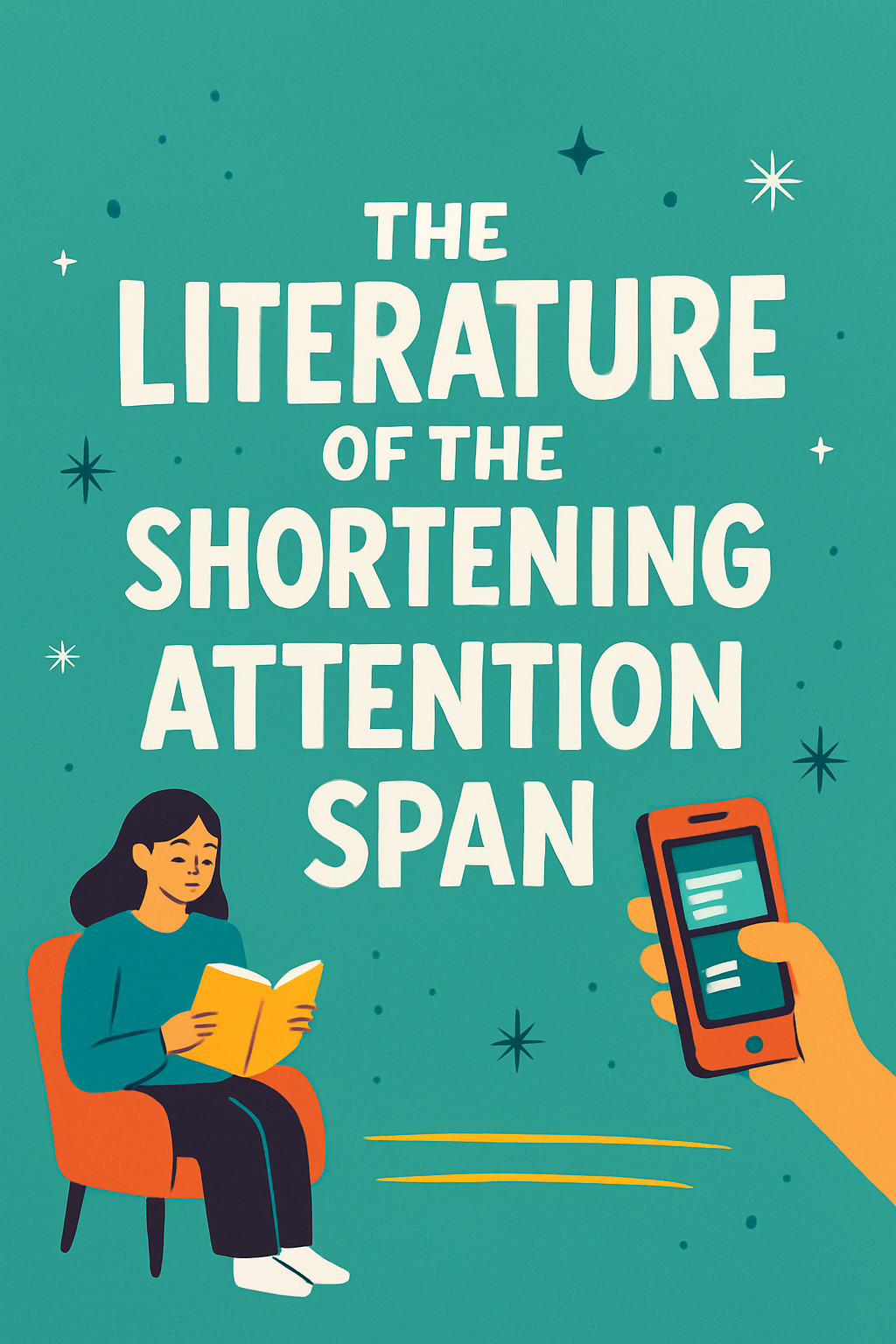
We live in an age where content competes for our attention in increasingly shortening bursts. In a digital world full of endless scrolling, how is the shortening attention span of readers changing what books are written, published, and read?

In a quiet moment after a long day, reaching for your phone feels so much easier than cracking open a book. Sometimes the last thing I want to do is string two sentences together (the trials of an English student, I suppose), but scrolling through endless short-form video content and social media often leaves my brain feeling like mush. So why not just pick up a book?

Maybe it’s because reading a whole page - even a whole paragraph, at times - feels overwhelming. It requires a skill that we are quickly learning to withhold: our attention. And, when we do have the long-awaited opportunity to pick up a book, we realize we have to work for the dopamine rush that our phones provide with no effort.

All day, our attention is fought for: by our jobs, our homes, our families, our pets…and our phones. We all know how the algorithms work, and we joke about them constantly. Whenever some niche content appears on our screen, chances are the comments will read along the lines of “idk how I ended up here, but I love it” or “the algorithm knows me better than I know myself.”

So, what does this have to do with our desire to read a book?

Simply put, technology (social media, specifically) in our culture has altered our mass reading habits. Are there still people out there who read multiple books weekly? Absolutely! I personally know several. Does it also seem a bit improbable that there is someone out there who finds the time to read multiple books a week? Absolutely.

And why is that?

Because the short form content we love so much is reconditioning our attention span. Nowadays, asking an audience to concentrate on one thing for multiple minutes at a time (forget hours) is a tall order. We’ve slowly conditioned ourselves to receive low-effort, fast-acting dopamine. All we have to do is sit and stare at our phone. (I know I’m guilty of it.)

Our attention span has adapted to a dopamine cycle of instant gratification that prioritizes speed over depth, and I think this has begun to reflect in our literature. Not just in how we read a book, but in what books we are picking off the shelves at Barnes & Noble.

In selecting a piece of fiction, there are two general categories: low-effort and high effort. I asked ChatGPT how it might define the conventions of both low and high effort fiction. Here is what it generated:

Low-effort fiction generally centers on -

  • Simple language (often verging on juvenile)

  • Plot/trope-based storytelling with instant gratification

  • Sex or trauma-forward marketing (‘emotionally devastating’ or ‘spicy’)

  • Fanfiction pacing and structure (alternating POVs, cliffhangers, emotionally unearned arcs)

  • Algorithm appeal (designed to hit niche markets via TikTok aesthetics (‘morally gray man,’ ‘feral girl energy,’ ‘he falls first’).

High effort fiction generally centers on -

  • Dense or complex prose (often more philosophically or emotionally loaded)

  • Thematic or philosophical weight (often no clear resolution, and ambiguity is intentional)

  • Formal Experimentation (structure is nonlinear or fragmented)

  • Slow or Ambiguous Plot (focus is often interiority, not action)

  • Intertexuality/literary References (expects you to recognize, or at least sense, echoes of philosophy, art history, mythology, or other literature)

  • Moral Ambiguity/psychological complexity (you’re not told what to think or feel about characters)

Platforms like TikTok and Youtube are saturated with content that reviews, summarizes, and recommends books (we don’t even have to blind guess anymore, we can just read Goodreads comments). Consumers buy those books. Sales go up. And suddenly, ‘low effort’ content is in the spotlight.

While both categories have their merits, there is one ruling difference: the amount of effort it requires of you—the reader—in order to engage with a text. Low-effort content is easier to read. It feels comforting and predictable because, chances are, you’ve read the same story (with slightly different characters or settings) a hundred times. It’s safe, it’s known, it’s relaxing. This also means it can get boring fast. On the other hand, high-effort content expects something of you. Whether that is pre-existing knowledge (bite the bullet, use a dictionary) or reading to the end of the chapter (I’m looking at you, Zadie Smith), high-effort content respects a reader’s intelligence. It demands reader accountability. It wants you to engage. And in a world where we are used to swiping up the moment we feel dissatisfied, it’s no wonder low-effort content is flying off the shelves.

There has always been a limitless range of subjects and genres to read from, but within the last 5-7 years, the literature market has seen high profitability from ‘low effort’ literature. Why is that? We’ve been through a lot in the last five years alone. We don’t want to dwell on heavy topics that require homework to understand. We want a real break from life. Something easy to pick up and put down, fast-paced, and something that keeps going (stability). We want a low-effort, easy-dopamine ‘pick-me-up,’ sound familiar? (See Sarah J. Maas, Emily Henry.)

Because here’s the larger problem: if we’re continuing to desire increasingly low-effort literature, what does this mean for literature in the long run? Where are the stories that will guide us, teach us, grow us? Storytelling is inseparable to the experience of being human. What happens when we don’t have the time of day for it anymore because we’re chasing a dopamine high?

Don’t get me wrong, I’m not saying there’s anything wrong with picking up a new ‘low-effort’ read, (sometimes that’s just what TikTok ordered), but I do think there is merit in taking on a challenge to read outside of your preferred genre. Even if it takes you forever, you’re feeding your brain by doing something different. Sample the buffet because you can, have fun with it!

So, whether you pick up a cozy fantasy, tumble headfirst through the Library of Babel, ask yourself: why am I reading this? Are you looking to be comforted, challenged, or distracted? (Trust me, the dopamine is sweeter when you earn it.) In a world where attention is our most valuable commodity, our literature is being reshaped by what we’re willing to spend it on. So, every so often, switch it up. There are so many stories out there waiting for you to give them a try.

You are the market, and there is power in what you buy, read, and share. If you want more of a certain kind of story—read it. Talk about it. Post about it. Be vocal. Literature can still stretch us, slow us down, make us think, and help us grow, both as individuals and as a community. But whether you’re reading something ‘low’ or ‘high’ effort, just keep reading!


From Swords to Swoons: The Addictive Allure of Romantasy

Romantasy is the newest hot trend in genre reads, but how much do we really know about these books? This sub-genre of romance and fantasy is currently targeting young and new adults by taking over social media discussions. It’s time to learn more about why this sub-genre is so popular and how authors can start to expand the creative reaches of their romantasy stories.

The 5 Best NaNoWriMo Apps for Planning & Plotting Your Novel (HINT: Start Planning in October)

This is the year! You are SO IN! You’re going to knock out 50,000 words in November, then spend the next few months revising and adding until you have that glorious thing: a completed novel, polished and shiny, ready to be sent out to an eager world.

You got this. But as every writer knows, before you begin, you need to lay out your tools: cup of coffee, notebook and pen for helpful scribbles, laptop or tablet . . . and the right apps.

PLANNING IN OCTOBER

Planning is the fun part! But that’s the danger: you can get lost in planning and diagrams and research and oops! It’s almost Thanksgiving. Don’t succumb: come November 1, be churning out your one or two thousand words a day.

In October, though, plan away. Scapple ($14.99 for Mac and Windows; free to try for 30 days), from the people who brought you Scrivener, the writer’s best friend (see below), is a simple mind-mapping app that allows you to plop down characters, events, or ideas and connect them with lines, shift them around, or arrange them however you like. Like scribbling on a whiteboard, but faster.

The Cult of Mac also points us to Lists for Writers, $2.99 for iPhone/iPad or Android. When you’re writing fast—and you’ll be writing fast—this is a great go-to for prompts and ideas. What kind of hair does the bridegroom have? What does my earth-bound angel actually do for a living? What attitude does my super-spy’s husband have toward her work? Flick through a list, grab a likely answer, and go. This app will stay useful well into November.

WRITING IN NOVEMBER

Scrivener ($45 for Mac and Windows; $19.99 for iOS (universal); free to try for 30 days) is often accused of having a cult, and if that’s the case, I’m a happy member. I’ve been using it for nine or ten years, first on large business documents at my then-day job, and then as a novelist. I genuinely do not understand how people write big projects without it. Some of my favorites of its many features:

  • Allows you to break your work into chunks – chapters and scenes—that you can color code and swap around easily in the “binder” that organizes them on the left of your screen.
  • Gives you a place to keep all your research right within the project. Photos, sound clips, videos, PDFs, entire web pages—they’re right there at hand in your research section.
  • Split screen feature allows you to have two windows open at the same time. Describing a magic raven? Pull up your raven photo and set it right next to the scene you’re typing in.
  • The project word counter tracks your progress every writing session and alerts you when you’ve hit your goal—useful for NaNoWriMo.
  • And of course, Scrivener easily exports your document into Microsoft Word format so that you can send it out into the world.

Some people find Scrivener a bit intimidating initially. With so many ways to help you write, research, and organize, using it for the first time can be like sitting down to the controls of a jet plane. Here are three key things to know if you’re new to Scrivener:

  1. If you’re planning to use it for NaNoWriMo, get it ahead of time and play around a bit to see if it’s for you.
  2. The Scrivener tutorials are famously excellent, so give one a spin.
  3. Forget about all the stuff it can do. Just begin by using its most basic features—the binder that organizes your documents, and the Research folder—and don’t worry about the rest. Those two features alone can be writer’s-life-changing.

For years Scrivener cultists, I mean fans, have been begging the creators for an iOS version, and it’s finally here. Now you can sync a project to Dropbox and work on it anywhere, from the coffee shop to the line at the post office. The transition to iOS was worth the wait: Macworld gave the iOS version a four-and-a-half mouse rating and said “Scrivener for iOS does just about everything you could ever need in order to research, plot, and write a short story, doctoral thesis, novel, or a review like the one you’re reading right now. . . a robust, flexible writing tool that will serve you well.” (Note that because of screen size limitations, a few features are not available on the iPhone version.)

Tried Scrivener, and it’s not for you? Ulysses (Mac ($44.99) and iOS ($24.99, universal) (sorry, Windows and Android users) gets raves from the Scrivener-decliners. One iTunes reviewer said, “Ulysses hits perfectly between the hack of using a standard word processor and folders to create long-form writing, such as a novel, and the too-much-to-be-worth-the-effort kitchen sink approach of Scrivener. I have become many times more productive since I started using it and it quickly, quickly, QUICKLY justified itself in terms of cost.”

The Mac desktop app has been around for a decade or so, and a 2010 Macworld review sings the praises of its clean interface and “superb design.”

The Ulysses iOS version is new this spring, and the five-mouse Macworld review is a rave beyond raves.

Finally, if NaNoWriMo (or any writing, really) demands anything from you, it’s time management skills. That’s where the Pomodoro Timer (iOS and Android, $1.99) comes in. This little app keeps you writing for 25 minutes, then gives you five minutes to stretch, walk around, or play on Facebook. But it dings you back to work when that five minutes is up. Let this bossy, cheerful tomato keep you churning out words.

Good luck! And remember the Rule of First Drafts, coined I am not sure by whom, which should become your mantra for November: The only thing a first draft needs to be is done.

Ready? GO!


Fantasy Vs. Contemporary: How to Let Your Character Dictate the Story — No Matter the Genre

Fantasy vs contemporary novels

Back in 2009 (how could it have been that long ago!!!!) when I started writing Infinite Days, I was compelled by my main character, Lenah, and her voice. Infinite Days is a book about Lenah, a 592 year old vampire, who gets a second chance to be human. I was enthralled by this character who had seen so much darkness, reveled in it in fact,  and who had to relearn what it means to be human. She experiences love, compassion, envy, and more. When I first heard Lenah’s voice (I'm going to sound nuts) she came to my mind clearly. I could literally channel her and I understood how she would speak.

She's quite tortured, you see. That’s Lenah. That sentence you just read - that’s how she would talk. I would never say “quite tortured.” Anyway (I’ll move on before you call the looney bin), she had a clear conflict. At the time I had never read a single Twilight book and was unaware of the paranormal explosion in the YA fiction world. I wrote Infinite Days in eight months. From Lenah’s conflict came the story. Her emotional needs drove the conflict, not the other way around. I didn’t create the supernatural rules/lore for the world first, but with what the character needed. As a vampire, Lenah wanted to be human more than anything. So, to push her to want it even more, I took away any aspect that was remotely human from the vampire experience: the more she aged the less she would be able to experience the sense of touch, the only sense of taste was blood and flesh, and the ability to love waned over time. So much of our human experience is about being out in the world with other humans. As a vampire, Lenah couldn’t be out in the daylight. After a while, that kind of isolation drove her insane.

As I explain the process now, I think it probably seems like I was totally aware of all of this but I wasn’t. I’m a big believer in Robert Olen Butler’s “white hot of the subconscious.” Olen Butler says in his book From Where You Dream: “Art does not come from the mind. Art comes from the place where you dream. Art comes from your unconscious; it comes from the white-hot center of you. Does this make sense? Do you understand what I'm saying? If you want to think your way into your fiction, if you think you can analyze your way into a work of art, we're going to be totally at odds philosophically about what art is and where it comes from.”

I love that.

When I started writing a contemporary story, Between Us & The Moon,  I was already writing and drafting from a character-driven place, yet the rules had to change. In Lenah’s stories, anything was possible, which made my choices huge. But again, I narrowed the scope of those choices to anything that would push my character out of her comfort zone and inhibit her from getting what she wanted. So the choices got more specific.

Genre should never dictate the character’s emotions. As I hinted at above, a contemporary world in some ways narrows the scope of the character’s problems even further because of the sheer limitations as to what that character can and can’t do. A way to narrow that scope even further is to think about what your character needs. One of the best ways I can say to bridge the world of writing fantasy and contemporary is in the arc of the character.  

Try out the following 3 questions:

  1. Who is your character at the end of the story who he/she was not at the beginning?
  2. How did he/she get there? They have to earn that change. Without change you have no story.
  3. What does he/she want? Well, if he/she is a supernatural creature, does the world in which the live making it harder for them to get what he/she wants? If your answer here is something abstract like: she wants happiness! That’s not specific. That’s abstract. What is something specific that your character can do in the story that represents “wanting happiness?”

Playing God: Mastering the Omniscient Point of View in Fiction

It’s old-fashioned.

It’s much harder to pull off.

Lots of people will warn you against it.

But if you do it right, it can crack your writing open in the best way.

Omniscient point of view—that godlike narrator who knows it all—is out of fashion. These days, the most common POV in fiction is “third-person close.” That’s where the narration only sees what your main character sees, only knows what she knows, can only speak her feelings.

But an omniscient narrator knows much more than what’s happening in front of and inside the main character. The omniscient narrator knows what all the characters see and feel and know, as well as things none of them know, like what’s past and to come.

People will warn you that omniscient POV is less intimate. Third person allows the reader to slip into a single consciousness, to identify with just that one, and see the others as threats or objects of desire. You know: like you do in your own head every day. And there’s absolutely nothing wrong with that—many, many brilliant books and stories use third person close. It’s also much easier to control than omniscient POV.

But omniscient POV offers other readerly (and writerly) pleasures. Many of the greatest novels ever written move in and out of intimacy with more than one character, so much so that that movement becomes almost a moral, mind-opening act. What are the odds: other people too have feelings and desires and fears.

The catch is that omniscient POV is tricky to do, and easy to get wrong.

Omniscience vs. Head-Hopping

You’ve probably heard about the horrors of head-hopping. That’s when a writer carefully establishes third person close with one character, and then without warning randomly drifts into other people’s heads. This is extremely confusing to the reader—it breaks a sort of pact made in the opening pages. It’s also the kind of amateur mistake that will make agents and editors write you off.

Imagine that you’ve just started a book in which you’ve followed Karen for two or three pages throughout her busy day at the office and into an interview with a job applicant. Here we are on page four:

Karen stifled a yawn as she glanced again at the resume. It was all becoming so tedious, and she had paperwork to finish before lunch. She looked up at Steve, smiling a bright, false smile. Steve wondered if this meant he’d gotten the job.

Screeeeech. What? The reader is immediately disoriented—I thought we were sticking with Karen?

If you’re writing from the first person or third person close POV, the solution is simple: never, ever head-hop. But if you’re writing from an omniscient POV, you may move from one character’s thoughts to another’s. So how do you avoid the kind of head-hopping that’s the mark of a novice writer, one not yet ready for publication? These two rules of thumb are a start:

1)   If you’re using an omniscient POV, establish it in the first paragraph or two.

2)   Don’t try to give everyone’s thoughts and feelings. Especially in any single scene, stick with just one or two, three at most.

Learn from the Masters

Let’s look at an example of moving from head to head that works. I could have pulled from Dickens, Hemingway, or many others, but the real master of this form is George Eliot. Here’s the end of a brilliant scene from Middlemarch, in which idealistic Dorothea is giving her heart to the (rather tedious and awful) Mr. Casaubon, rather than to Sir James, whom she does not even notice is courting her:

Dorothea colored with pleasure, and looked up gratefully to [Mr. Casaubon]. Here was a man who could understand the higher inward life, and with whom there could be some spiritual communion; nay, who could illuminate principle with the widest knowledge, a man whose learning almost amounted to a proof of whatever he believed!
Dorothea’s inferences may seem large; but really life could never have gone on at any period but for this liberal allowance of conclusions, which has facilitated marriage under the difficulties of civilization. Has anyone ever pinched into its pilulous smallness the cobweb of pre-matrimonial acquaintanceship?
“Certainly,” said good Sir James. “Miss Brooke shall not be urged to tell reasons she would rather be silent upon. I am sure her reasons would do her honor.”
He was not in the least jealous of the interest with which Dorothea had looked up at Mr. Casaubon: it never occurred to him that a girl to whom he was meditating an offer of marriage could care for a dried bookworm towards fifty, except, indeed, in a religious sort of way, as for a clergyman of some distinction.

Let’s break down this classic omniscient POV:

  • Paragraph 1: Dorothea’s thoughts
  • Paragraph 2: Omniscient narrator comments drily on Dorothea’s thoughts
  • Paragraph 3:  Sir James’ words
  • Paragraph 4: Sir James’ thoughts

Advantages of Omniscient POV

The omniscient POV gives you the option of taking some distance on your characters—you can move in and out of their heads, deeply feeling their feelings, and then zooming out to comment on them.

Also, your all-knowing narrator knows things the character does not, and things the reader does not. This gives you, as a writer, tremendous flexibility in dropping hints about backstory or foreshadowing what’s to come.

Here’s an example in which the narrator comments, gives new information, and offers foreshadowing. It’s from my first book, Summer and Bird:

So Bird slept in the forest with the birds that night, only a weak, flickering fire between her and the black cold. Summer slept under the stars, wrapped in Ben’s red sweater. But each of them fell asleep turning over the same questions in her heart: Where is my mother? Where is my father? Where are they, where are they, where are they.
The answer is that they, too, were in Down, but far apart, and far away.
Their father sat in a boat that sat on dry land.
Their mother lay deep in the ground, but alive.
And their father’s heart and their mother’s heart each longed for their girls, just as the girls longed for them. A full house of longing hearts, though a house split open and scattered, far from where it began. But even scattered as they were, the strands of longing from those four hearts met in the sky and twined in harmony, making one sad, silent song.
But another heart, a discordant heart, had thrust among them. This heart had spoiled the family’s music for many years, though they did not know it. And this heart’s ravenous longing sounded not like any music, but like the scream of a cat, or a hawk when it kills. This was the Puppeteer’s heart, and the Puppeteer’s long claw was coming very near one small, cold, sleeping girl.

 Using omniscient POV here allowed me to do three things:

  1. Provide tantalizing bits of information to the reader that the characters themselves do not know (where the mother and father are; that the Puppeteer has been messing with this family for years)
  2. Show that the two sisters, though far apart and angry with each other, are emotionally in precisely the same place
  3. Foreshadow that the Puppeteer has her eye on one of the girls.

I could not have done any of that using any other POV.

All About That Voice

For me, as much as a first-person narrator, the omniscience narrator is all about the voice. Who is telling you this story? Why are they choosing certain elements to focus on? What attitude do they have to the characters and the story they are telling? Ironic and distant? Flat and emotionless? Merry and wry? Sad and philosophical? Bitter and snarky? Slightly insane? Trying to scare you, trying to make you cry?

How you answer those questions is how you weave a voice.

Some people talk about narrators that have an “objective perspective.” I say that’s nonsense—there’s no such thing. Your narrator will always have a perspective, a stance— that’s what POV means. Sometimes it may be a quite cold, distant perspective, but that is still a perspective.

Omniscient POV can definitely be a challenge, and it takes even more work in the writing and revising to get it right, compared to other POVs. But just because you’re not George Eliot or William Faulkner, you don’t need to fear it. Explore this technique in a short story, perhaps, and see what it has to offer you.


Katherine Catmull is a novelist, arts writer, playwright, and business and political writer and editor. Her first novel, Summer and Bird (Dutton Juvenile/Penguin), was named one of Booklist’s 2012 Top Ten First Novels for Youth and was both an IndieBound New Voices Pick and an Amazon Editors’ Pick. She is also a co-author of a collection of scary short stories, The Cabinet of Curiosities (Greenwillow/HarperCollins, 2014). Her next book with Dutton comes out in Winter 2016. Katherine has worked as an editor with a whole range of people, from novelists to college students to members of Congress. She spent twenty years in business and politics, working with politicians and CEOs to help them find just the right words to get their message across.

AREAS OF SPECIALTY: Literary fiction, historical fiction, memoir, YA and MG, urban fantasy, magic realism, comic novels, history and criticism, mysteries, narrative non-fiction.

AVAILABLE FOR: Manuscript critiques, developmental editing, content or line editing, writing coaching for adults, writing tutorials for kids, and first chapter critiques.

HIRE KATHERINE TO EDIT YOUR MANUSCRIPT!
CLICK HERE TO REQUEST A QUOTE.