

Fiction

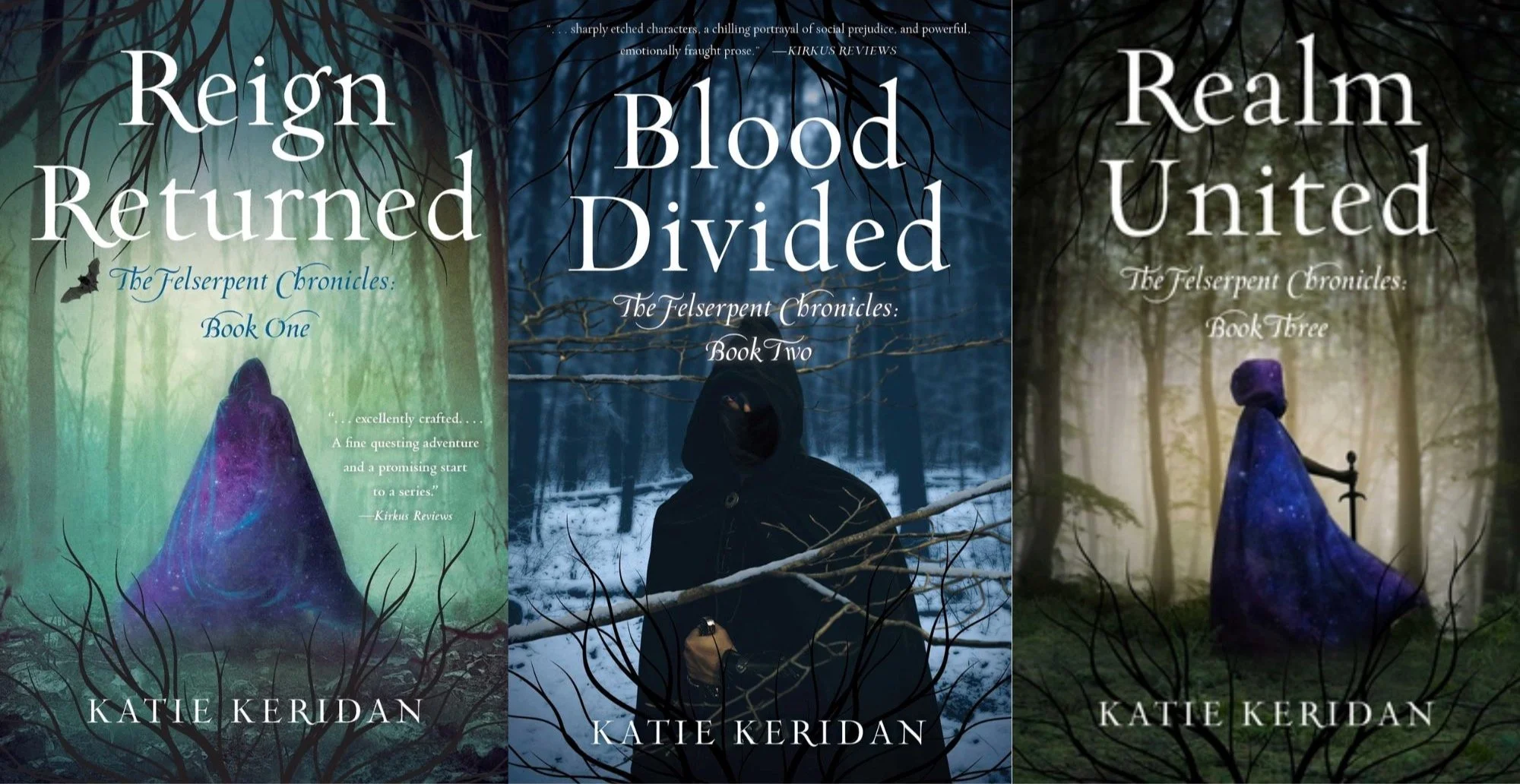
Success In the Press: The Felserpent Chronicles by Katie Keridan

2023 National Indie Excellence Award Finalist in YA Fiction ★ 2022 Foreword INDIES Finalist in Young Adult Fiction ★ 2022 Best Book Awards Finalist in Fiction: Young Adult ★ 2022 American Book Fest Best Book Awards YA Fiction Finalist ★ 2023 Reader Views Literary Awards Bronze Award Winner in Young Adult

2023 National Indie Excellence Award Finalist in YA Fiction ★ 2022 Foreword INDIES Finalist in Young Adult Fiction ★ 2022 Best Book Awards Finalist in Fiction: Young Adult ★ 2022 American Book Fest Best Book Awards YA Fiction Finalist ★ 2023 Reader Views Literary Awards Bronze Award Winner in Young Adult ★
“𝐏𝐥𝐚𝐜𝐞 𝐨𝐧𝐞 𝐩𝐞𝐛𝐛𝐥𝐞 𝐢𝐧 𝐚 𝐫𝐢𝐯𝐞𝐫 𝐚𝐧𝐝 𝐢𝐭 𝐦𝐢𝐠𝐡𝐭 𝐛𝐞 𝐰𝐚𝐬𝐡𝐞𝐝 𝐚𝐰𝐚𝐲,” 𝐈 𝐬𝐚𝐢𝐝. “𝐁𝐮𝐭 𝐤𝐞𝐞𝐩 𝐩𝐥𝐚𝐜𝐢𝐧𝐠 𝐩𝐞𝐛𝐛𝐥𝐞𝐬 𝐢𝐧 𝐚 𝐫𝐢𝐯𝐞𝐫 𝐚𝐧𝐝 𝐞𝐯𝐞𝐧𝐭𝐮𝐚𝐥𝐥𝐲, 𝐲𝐨𝐮’𝐥𝐥 𝐜𝐡𝐚𝐧𝐠𝐞 𝐭𝐡𝐞 𝐜𝐨𝐮𝐫𝐬𝐞 𝐨𝐟 𝐭𝐡𝐞 𝐫𝐢𝐯𝐞𝐫.”

From the Author:

Kyra Valorian is the most gifted Astral healer the golden-blooded realm of Aeles has seen in ages. When tragedy strikes, Kyra discovers a life-altering truth: she’s a Recovrancer, able to reach into the realm of the dead and bring back those who’ve died before their time. But recovrancy is outlawed, and desperate for answers, Kyra forms an unlikely alliance with Sebastian Sayre—a silver-blooded Pyromancer and feared Daeval assassin chasing a legendary sword lost to his people. As the two navigate forbidden magic, fractured history, and the dangerous tension between their realms, their fates begin to entwine in ways neither expected. What starts as a tactical partnership soon becomes something far more powerful.

This epic fantasy trilogy blends enemies-to-allies tension, slow-burn romance, magical warfare, and a sweeping sense of destiny across all three books. With high stakes and emotional payoff, it’s a perfect fit for readers who love a strong magical system and a romance that grows in the shadow of war.

Our Take:

This award-winning trilogy blends forbidden magic, richly imagined realms, and a high-stakes magical conflict that deepens with every book. The pacing balances action with atmosphere, offering immersive lore, vivid elemental magic, and a central mystery that gradually unravels across the series. With themes of legacy, power, and the cost of rewriting fate, it’s a satisfying read for fans of romantasy and fantasy politics alike—especially those looking for a completed series with strong payoff and a cohesive, sweeping arc.

From A Reader:

Magical worlds, love that endures throughout time and space, dragons, spells, animal familiars, and the fate of worlds hanging in the balance. This is a truly delightful addition to the fantasy genre. I’m eager for this series to continue so I can find out what happens next.”

Bragging Rights:

★ 2023 National Indie Excellence Award Finalist in YA Fiction

★ 2022 Foreword INDIES Finalist in Young Adult Fiction

★ 2022 Best Book Awards Finalist in Fiction: Young Adult

★ 2022 American Book Fest Best Book Awards YA Fiction Finalist

★ 2023 Reader Views Literary Awards Bronze Award Winner in Young Adult

Additionally, all three novels received excellent write-ups from Kirkus Reviews, and Blood Divided was selected to be featured in their July 2023 issue. Less than 25% of indie authors are featured! Here are some of our favorite quotes from each Kirkus review:

Reign Returned: “…excellently crafted…A fine questing adventure and a promising start to a series.”

Blood Divided: “…sharply etched characters, a chilling portrayal of social prejudice, and powerful, emotionally fraught prose.”

Realm United: “A fantasy novel full of romance, politics, and the quest for identity, sure to appeal to young adults.”

Get your copy today at the links below!

Amazon | Goodreads | Author Site

From Swords to Swoons: The Addictive Allure of Romantasy

Romantasy is the newest hot trend in genre reads, but how much do we really know about these books? This sub-genre of romance and fantasy is currently targeting young and new adults by taking over social media discussions. It’s time to learn more about why this sub-genre is so popular and how authors can start to expand the creative reaches of their romantasy stories.

Success In the Press: Sunchaser by Shannon Lynn

#1 Amazon NEW RELEASE in Children's Dystopian Science Fiction

Amazon TOP TEN BESTSELLER

#1 Amazon NEW RELEASE in Children's Dystopian Science Fiction ☀ Amazon TOP TEN BESTSELLER ☀

Illustrated by Ruth Ann McCombs

From the author:
Tom Raynor spent every hour of every day wishing he was somewhere else—anywhere else that was outside the interplanetary city-ship that he had called home for all eleven years of his life. When Tom accidentally initiates the autopilot of a commissioned light sail ship, he finds himself careening through space toward a planet thought to be uninhabitable for generations. Once the runaway ship lands, Tom fumbles through misadventures and near-death experiences instigated mainly by his increasingly-becoming-a-problem curiosity and impatience.

Our take:
This energetic middle-grade sci-fi adventure launches readers into a richly imagined universe with a hero who’s equal parts impulsive and endearing. With classic space exploration vibes and a steady stream of near-misses, The Vesta Chronicles: Sunchaser strikes a smart balance between high-stakes survival and heartfelt growth. A great fit for young readers who love scrappy protagonists, crash landings, and stories that blend action with just the right touch of humor.

From a Reader:

“Absolutely awesome and adventurous sci-fi with a captivating storyline and interesting characters you just want to get to know! Excellently written book than is great entertainment for all ages; and a book that you won’t want to put down. Can’t recommend it enough and am already looking forward to the next installment!!”

(ALT REVIEW) “This book was perfect for my 8 and 11 year old boys! This was a great sci fi-dystopian series set between space and the Texas hill country. We were all drawn in from the beginning (…) My boys love dressing up as cowboys and astronauts so this book had them gearing up for both!”

Amazon | Goodreads | Author Site

The Art of Promise-Keeping: Paratextual Clues and the Reader Experience

By Jack Kaulfus

We all know that books are more than just words: they’re little worlds between covers. As writers, we’re often mostly concerned with getting our stories to reflect the visions we’ve been working out for months on end. We’re hoping to keep our reader so engaged on the page that by the end of the book, they’ve had a highly curated experience with our specific little world. We want our characters to be perfectly rendered through dialogue and action, our settings to be expansive and meaningful, our themes to emerge with beauty and grace. 

However, if you’re only thinking about words, you might miss opportunities to create a more fully realized experience of story for your reader. Readers have been trained, over the course of their reading lives, to expect certain aspects of books to reveal information about the story inside. This means you have a unique storytelling opportunity to meet, enhance, or completely subvert their expectations. 

Enter The Paratext

According to Allison Parrish, French literary theorist Gérard Genette introduced the term "paratext" to describe elements like prefaces, introductions, dedications, and epigraphs. These can also take hypertextual forms, such as footnotes, tables of contents, indices, and bibliographies.

Think about your own habits when choosing a new book to read. Where do you look first? Despite the adage, a lot of us do judge books by their covers. We’re all aware that cover trends exist, and that the artwork often relays both genre and tone. Where do you look next? I’m in the habit of reading the summary on the back (or inside flap), glancing over the names of writers who have offered blurbs, finding the picture of the author (or noticing when there is none), and taking note of the publisher. All this before I even open it to see what the writing is like. 

Once I open the book, I flip through the pages to see if there’s anything interesting happening formally. I love to see footnotes in a fictional work, or what looks like a random illustration in what otherwise seems like a traditional narrative. These little details build readerly anticipation in me, and pique my curiosity about what the writer has in store.

Table of Contents + Chapter Titles

Your reader may not be consciously aware of it, but the table of contents plays a big part in setting expectations around narrative structure, tone, and pacing. Many novels don’t include a table of contents and don’t necessarily need one, but because the table of contents are at the beginning of the book, and are likely one of the first pages your reader will see. You can use those first couple of pages to your creative advantage if you like.

Consider The Love Songs of W. E. B. Du Bois, by Honorée Fanonne Jeffers. Her table of contents provides insight into genre-defying, generational themes in the book. Each section is an unnamed song, and each chapter title reveals information about the family structure at the heart of the narrative.

You can also make decisions about pacing by separating your book into parts. Most readers have been primed for traditional narratives with three acts: the setup, the confrontation (challenges, etc), and the resolution. Your book does not need to follow the traditional narrative structure – plenty of fantastic books don’t – but you have an opportunity to either effectively telegraph Checkov’s gun, or pleasantly surprise your readers by upending their expectations about what comes when. 

Prologues, Epilogues, and Epigraphs

Framing devices fall in and out of favor, and they fit some narratives better than others. They tend to show up in sprawling novels with a lot of world-building, and provide a formal sense of structure. Prologues are not useful when they’re used as an expositional catch-all or a gimmicky hook. Most readers want to get started right away, and may skip the prologue altogether if it is overly long or seems to have nothing to do with the story. However, if your book has some experimental elements in it – if it slides into meta-territory or follows a nonlinear timeline – the prologue is a good place to creatively introduce some of those elements. 

Epigraphs are those quotes that show up at the beginning of the book (or sometimes at the beginning of chapters). They’re usually from familiar or historical works, and the aim is to provide allusive weight to whatever’s coming next in the book. Epigraphs can provide context, frame your book as part of an ongoing literary conversation, or prepare the reader to look out for upcoming themes. If you’re thinking about including epigraphs in your book, consider what you’re imparting the reader. Are you communicating something personal you want your reader to know about you as an author? Are you aligning your work with the one in the quote? Are you adding depth to character? Courtney Maum has some interesting viewpoints on why and how some epigraphs work better than others on her substack.

Footnotes and In-Story Artifacts

The first time I came into contact with footnotes in a semi-fictional work, I was enthralled. I found an airport read in the early 90s, and as my plane took off, I dove head-first into David Eggers’s A Heartbreaking Work of Staggering Genius. Since then, I’ve been partial to works that use this conceit. Fictional indexes provide a similar thrill for me. The reason is simple: though obviously a work of popular literature, I begin to employ some of the same critical reading practices that I use with scholarly works. I’m no longer a passive reader – I’m entering into a kind of collaboration with the writer, and it feels like we have a tacit agreement that I’m going to find more inside this book than I expected. Carmen Maria Machado’s memoir In the Dream House brought footnotes to a whole new level – one that rewards readers who revisit the book.

I feel similarly about other artifacts that pop up in unexpected places: random-seeming illustrations, a harried-looking grocery list, or text thread between side characters. Though N.K. Jemisin doesn’t love maps in fantasy novels (they’re basically spoilers), she did end up posting one for The Fifth Season series online, and now the maps are included in all her books. 

Doug Dorst’s and JJ Abrams’s novel “S” uses paratextual elements to create a story within a story – an alternative narrative between characters who are only communicating through margin notes. As their relationship deepens, so does the reader’s understanding of both stories. And because we’re living in a time when our access to media allows for stories to  develop both in-universe and on virtual platforms, paratexts may now easily jump from page to screen to headphones. Plenty of books, especially in the romance genre, now include song playlists so readers can create story-specific ambience each time they crack open the book. 

So it's not just about what's on the page, it's about everything around it too. As writers, embracing the power of paratext offers a fantastic opportunity to deepen our connection with our audience and craft an immersive literary experience. While our primary focus will always be on crafting compelling narratives with well-wrought prose, paratextual elements offer us subtle and meaningful ways to actively shape the reader’s journey through each little world.

Writing Dialogue: The 5 Mistakes Beginning Writers Make

Hi writers! We kicked off 2019 with a new 4-part blog series called “Craft Q&A.” In this series, we tackle real questions submitted to us by Yellow Bird clients. Each question pertains to the craft of writing fiction. Without further ado, we present today’s question about writing strong dialogue:

QUESTION: “I honestly feel like my dialogue could be a lot better. It either feels too stiff or too rambling. Do you have any advice about how to get better at writing dialogue?”

dialogue pic.png

Dialogue is a natural part of life, serving as a bridge between individuals and characterizing the speaker. Just as conversing is important in any relationship or interaction, dialogue between characters is critical to a story. It provides readers with a direct link into the scene and gives us a glimpse into the immediate thoughts of characters. However, crafting authentic dialogue is a challenge that many of us struggle with. It’s easy to overthink the dialogue, resulting in these common dialogue mistakes.  

Mistake #1: Using formal dialogue that doesn’t sound natural

 Avoid excessively polished dialogue that comes across as stilted and unnatural. You wouldn’t have this conversation with a friend:

“Hello, Morgan. You are looking better today.”

“Thank you for noticing, Alex. I am feeling a lot better. I do not feel as sick as I did yesterday.”

“That is good news, I hope your health continues to recovery.”

People use contractions in everyday use, so they should occur in your dialogue as well. Additionally, while we call out names in order to get people’s attention, we don’t normally address someone by name when we’re talking exclusively to them. The above conversation would probably look more like this:

“Hey dude, you look so much better today!”

“Oh, thanks! Yeah, I definitely don’t feel as bad as I did.”

“I can tell. I’m glad! Get more rest.”

Overthinking the dialogue can result in rigid conversations that don’t actually take place in real life. Making the dialogue realistic to your setting is important to keep in mind, as well as remembering your character’s personality and how their diction might differ from one another. Going back through and reading your dialogue out loud is a good way to ensure it sounds realistic and natural.

Mistake #2: Using dialogue that sounds TOO natural

On the other hand, many people say “um” and “like” in real life, sometimes multiple times in a sentence. That’s just the natural way we speak when we have to pause and think about what to say. However, readers don’t want all these placeholders when they’re reading text. While those superfluous bits are normal for everyday conversations, dialogue between characters is not meant to contain such filler. Reading someone say “um” between every other word can make it hard to decipher the meaning of the dialogue.

Maybe a character is talking to their high school crush and gets flustered while stumbling over their words. In that case, the ums and likes would add important characterization to the scene, conveying the overwhelming nerves that take over in the moment. These techniques can have an effective impact when used carefully, but they should be used sparingly — in most instances, try to instead let descriptions of body language and natural pauses in dialogue convey the characters’ emotions.

 Mistake #3: Not inserting enough dialogue tags.

Dialogue tags are such a natural part of stories that they are almost invisible. Yet, while readers don’t often notice them at all, there’s an art to these little markers. The main purpose of dialogue tags is to prevent confusion about who is speaking. They serve a functional purpose before anything else. Using not enough dialogue tags can lead to confusion about which characters are saying what, particularly if there are three or more people involved in the conversation. If a reader has to go back to count the lines in order to figure out who is speaking, you need to add more tags.

 Mistake #4: Going crazy with dialogue tags

While some people tend to forget dialogue tags, others make them more complicated than they should be. An overzealous author might write the following scene:

 “Where were you last night?” she demanded angrily.

“None of your business,” he muttered quietly.

“What did you say?” she shouted loudly.

“I said it’s none of your business,” he screamed back.

This exchange features redundant markers, particularly the adverbs describing the dialogue tags. The dialogue itself, along with actions, should convey the tone and mood of the speakers, so words such as “angrily” or “quietly” should not be necessary. While you may think you’re adding more description to the scene, you’re just being repetitious. Supplementing the dialogue with details about the scene can be more effective than adjectives and adverbs. You also don’t need to insert tags with every piece of dialogue, especially if it’s just between two people.

Some writers try to avoid “said,” opting instead for strong verbs (such as “demanded,” “muttered,” “shouted,” and “screamed” from the example above) to keep the text interesting. However, these can interrupt the flow of the story. Sometimes it is best to keep things simple. The majority of dialogue tags in your story should be “said” or “asked” so that you can focus on creating powerful imagery by showing the emotions and actions rather than telling them.

The above scene could be rewritten with fewer dialogue tags and more descriptions of the scene, such as this:

She heard the door creak open and looked up. “Where were you last night?” She asked, slamming her book shut.

“None of your business,” he said, avoiding eye contact while hanging up his coat.

“What did you say?”

He turned abruptly, looking into his wife’s eyes with a piercing, bloodshot look. “I said it’s none of your business.”

 Mistake #5: Filler dialogue

 Just as every word in your story should have a purpose, dialogue is no exception. You should never use dialogue as filler or small talk; instead, be intentional in creating meaningful interactions between characters. Dialogue can characterize characters in important ways or move the plot forward by having a character accidentally let a secret slip out. While dialogue can be a useful tool to add information to the story, avoid using dialogue to summarize events, and don’t use conversations as a way to dump information all at once. Pacing is critical to stories and specifically to dialogue as well.

 As with any writing technique, it takes time and many drafts to hone the art of dialogue. Also, remember that dialogue entails more than just the spoken word, so don’t rely solely on words to convey thoughts, emotions, and information. Dialogue is just one tool in the writer’s toolbox, so use it masterfully in order to create complex characters and an engaging story.