


Inevitable and Predictable, So Close Yet …
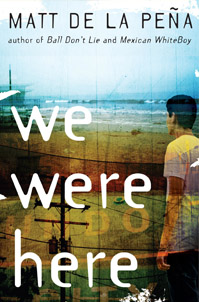
I just finished Matt de la Peña’s We Were Here (Delacorte Press, 2009). Not surprisingly, it kind of rocks. Don’t worry; this isn’t a review of a not so new book that you’ve probably already read. I only mention it because it’s a great example of inevitability. In case you haven’t gotten to it yet I won’t go into specifics, but the big reveal is far from surprising … in a very good way. Same with the novel’s ending.
The reason I didn’t mind figuring out the ending pretty early on is that de la Peña’s plot has inevitability. The hero’s choices drive him into increasingly difficult situations until he has to eventually confront the source of his self-inflicted torture. So always being aware of the story’s inevitable conclusion in the distance fits We Were Here‘s rough, urban journey. I found myself experiencing a growing satisfaction as I trudged alongside the book’s hero knowing where he was headed even when he didn’t. Paradoxically, and this is what I love about de la Peña’s writing, this dramatic irony also turned out to be the source of most of the story’s tension for me. I knew what the hero needed. It was painfully obvious. So I wanted to grab him by the scruff of his neck every time he took a step in the wrong direction. But in the end, the hero figured out the right course all on his own. He achieved redemption because he chose to. Like a worried parent, I could breathe again, my child had made it across the tightrope without my help.

And then there’s predictable. I’m talking bad TV sitcoms here. Unlike a story with a strong, inevitable ending, what the reader/viewer sees coming in a predictable plot isn’t really connected to the hero. It’s an outside force instead of a consequence of the hero’s actions. Therefore it feels like a cheat and leaves readers or viewers wanting more. Or worse, it leaves them wishing they’d never gotten suckered into the experience in the first place.
Okay, so we’ve established that we like inevitable endings and that tying our plot twists and crises to our protagonist’s choices helps us achieve them. Well, I’m hoping you’re with me on this; maybe my previous sentence should have been in the singular. Either way I shall plunge ahead.

Achieving inevitability instead of predictability also hinges on how delicately an author deploys the little signposts that get the reader wanting the ending everybody’s moving toward. A delicate balance must be struck. If de la Peña had peppered as few as one or two more bits of foreshadowing into We Were Here, the book could have ended up as just another formulaic and moralistic walk along an all too familiar adolescent beach.
I can’t help but imagine some early draft of the novel that looks precisely like that. Okay, I’ll admit it; Ihope that cliché early draft exists with all its flaws. I like to imagine it lying bloated at the bottom of some file drawer in Matt de la Peña’s office: an unremarkable stack of dusty pages held together by a single, overtaxed rubber band around its middle like a hobo’s belt. It’s petty, I know. But it’s an image that makes me feel better about my own writing process.
YA Novelist Brian Yansky on Writing for Boys, Part 2
[Below is part two of my recent email interview with YA sci-fi novelist, Brian Yansky. Here’s a link to the interview’s first part. My conversation with Brian is part of a larger series on teen male aliteracy, all of which can be found on the Yellow Bird Blog.]
BPW: I recently read a great essay by author Matt de la Pena about how becoming an active reader can change a man’s life, young or old. In our emails leading up to this interview you mentioned how reading “saved you” when you were young. How so?

BY: I didn’t start reading a lot until I was seventeen. Before that I was, to put it mildly, unfocused. I was close to flunking out of school. I knew the local police much too well, and they knew me. But when I started reading and writing (I started writing a diary because of the reading), I found a different kind of excitement from the kind that had been getting me into so much trouble. Reading and writing became healthy obsessions. They gave me focus. They gave me hope.
BPW: Andy Sherrod describes some basic differences between boy books and girl books. These have to do with the personality of the hero, the types of and settings for conflicts the hero must face, the narrative voice, and the use of factual information in the story. Your most recent novel,Homicidal Aliens and Other Disappointments, fits pretty neatly into all of Sherrod’s defining characteristics for a boy book. How did you come to specialize in writing for a young, male audience? Did you make a conscious choice?
BY: Well, like a lot of YA writers, I thought my first book was for adults. I found an agent who thought so too and tried to sell it. Several publishing houses liked it, but it didn’t sell. Then my wife and [YA novelist]Cynthia Leitich-Smith both encouraged me to think of it as a YA novel. I revised it a little but not much. It sold, almost immediately, as a YA.

I love writing YA characters. That age has so many possibilities. There’s a freshness to the world and experience and at the same time a naivety in some instances. It’s also a time of great change. There’s school and friends and first love and a lot of firsts. It’s just an interesting time, ripe with dramatic possibilities. It comes down to this: I’m excited and thrilled by writing characters this age. You should write what excites and thrills you.
BPW: Homicidal Aliens ends with a major victory for the protagonist but leaves one antagonist unaccounted for. Does this mean a third book is in the works? If so, can you give a little taste of what future annoyances readers can expect for Jesse? If not, what’s next on your writing horizon?
BY: My next novel is not a sequel. Alas, no more alien books. My next novel is called UTOPIA, IOWA, and will come out in early 2015. I just finished the final edits with my editor. It’s about this character who sees ghosts, but this is not the big deal to him because everyone on his mother’s side of the family sees ghosts. However, it becomes a big deal when a girl in his school is murdered, and she starts insisting he find out who killed her. I hope my main character, a–surprise,surprise– seventeen-year-old male, has a strong and interesting voice.
[If Yansky’s past heroes are any indication, his newest protagonist will indeed have a unique and memorable voice. Many thanks to Brian Yansky for his great answers here and for all of his great books. Earlier in this series, I asked Andy Sherrod for his boy book top ten. So it only seemed fair to ask the same of Brian. Here are his boy book recommendations:]

Chaos Walking by Patrick Ness
Unwind by Neil Shusterman
Godless by Pete Hautman
Looking for Alaska by John Green
The Great Green Heist by Varian Johnson (due out 2014)
The Absolutely True Diary of a Part-time Indian by Sherman Alexie
Cat’s Cradle by Kurt Vonnegut
The Bartimaeus Trilogy by Jonathan Stroud
His Dark Materials by Philip Pullman
The Book Thief by Markus Zusak

YA Novelist Brian Yansky on Writing for Boys

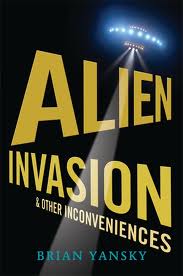
Brian Yansky writes YA novels and teaches writing at Austin Community College. In his books he tells the stories of teenaged boys. I first met Brian at the 2012Austin SCBWI Annual Conference. Since then I’ve been lucky enough to get to know him a little better and read two of his sci-fi novels, Alien Invasion and Other Inconveniences, and Homicidal Aliens and Other Disappointments. In addition to his full-time jobs writing novels and teaching at ACC, Brian sometimes teaches short format classes for The Writers’ League of Texas. Not to gush, but I can tell you from firsthand experience it’s worth the money to take one of these (usually half day) courses, because he teaches as well as he writes.
In many ways, Brian is the perfect example of a writer who is daring to buck some of the YA publishing trends I’ve been talking about in my ongoing series on the topic of teen, male aliteracy.
I posted a review of Homicidal Aliens on my personal blog late last week.
Here’s Part One of my recent email interview with him:
BPW: In Homicidal Aliens, just as in Alien Invasion before that, your first person narrator Jesse sounds exactly like who he is, a male teenager. Your language has a genuine plainness to it that’s highly effective. It’s also in keeping with what Andy Sherrod identifies as one of the defining characteristics of a boy book: the intense emotions the characters are feeling are undercut by your narrative voice. Is there a “real” Jesse whose voice you borrowed from? Either way, can you talk about developing your distinctly teen, male voice?

BY: First, thanks for saying that. I do want every character to have a distinct voice, and I struggle to make my characters sound the age they are. It may help that I suffer from arrested development, and a part of me still sometimes reacts like a teenage boy: “I have to do that? You mean I have to do that now?” So I do get in touch with my inner teenager when I write my young adult novels. I suppose the voice is some mix of my memories of myself and my friends at that age, my imagination, and my observation of teenagers – both in real life (one of the benefits of teaching at Austin Community College) and in the novels I read, movies and TV I see, songs I hear. The way a voice comes is a bit of a mystery, but as I’m building a character – adding specifics about how a character sees his world and what he does in it – the voice becomes clearer and clearer in my mind.
BPW: You successfully write for a teen audience. Do you have teen beta readers?
BY: I don’t.
BPW: Is it because you choose not to? Or is it more a matter of limited access?
BY: There are probably a few writers who do have teen readers, but none of my writer buddies do. Every writer is different though. I just do my best to be true to the character. Then I have a critique group, who all write YA and Middle Grade, read my work. Then my agent, who sells mostly YA and MG. Then my editor at Candlewick. So if there are places where the voice seems inauthentic, I get feedback. But, honestly, I rely mostly on my ear and, as I said before, a combination of observation, imagination, and memory.
Look for the rest of my conversation with YA novelist Brian Yansky in two weeks, and find out how discovering reading as a teenager changed his life.
Andy Sherrod on Teen, Male Aliteracy, Part Two
If you’re new to the conversation, today’s post is the second half of an interview I conducted with Andy Sherrod via email. Andy’s an expert on the related topics of teen, male aliteracy and male oriented children’s literature, or boy books. Click here to read Part One.
Here’s the end of our exchange:
BPW: I recently had a ten minute one-on-one with a literary agent at a conference who told me he couldn’t sell my WIP because he didn’t think it would interest girls. Putting aside the obvious conclusion that he simply hated my pitch and was trying to find a more generic reason to reject me, he’s a pro, a smart guy who sells manuscripts for a living. And he’s basically saying there’s no point in even trying to publish books for boys because they won’t read them. How would you answer him?
AS: I think you nail it by saying he’s a smart guy who sells manuscripts for a living. The key phrase here is “for a living”. You know, the book business is fiercely competitive. It’s no secret that girls are more engaged in active literacy than boys so marketing books to the wider audience makes sense if you are trying to feed your family. But where does that leave our boys? In 2007 the National Endowment for the Arts published an in-depth report on the reading habits of Americans. The report states that:
“As Americans, especially younger Americans, read less, they read less well. Because they read less well, they have lower levels of academic achievement… With lower levels of reading and writing ability, people do less well in the job market.”
What better reason do we need to encourage all our children toward active literacy? Just because it’s a challenge doesn’t mean it should be ignored.
[Here’s a link to the NEA’s most recent meta-study on American reading habits. It builds on the study Andy quotes.]
BPW: When I took your seminar last year I had no idea my then WIP was a boy book. I soon I found out I was wrong. Can you give ten reading recommendations for any writers out there who aren’t sure if they’re writing boy books or girl books?
AS: Web sites:
Guys Read (http://guysread.com/)
Jon Scieszka was the first National Ambassador of Young People’s Literature. His web site, GuysRead.com, is for parents, teachers, and kids. It contains lots of book titles that boys themselves say they like to read.
Michael Sullivan (http://talestoldtall.com/)
Michael is a teacher and librarian who reviews lots of books. Take your pick.
Andy Sherrod’s Big Boy Book Blog (http://andysherrod.blogspot.com/)
This is my own blog with observations and information for adults who want to better understand aliteracy.
Fiction:
Hatchet by Gary Paulsen (and other books in the Brian series)
This book is on many school reading lists already. Once a kid is hooked on Paulsen he will be reading for a very long time. Paulsen has published over 100 books. I love this guy.

Voyage series by Michele Torrey
Who says women can’t write for boys? Michelle Torrey has nailed all the literary components of a good boy book in this three-book series of historical fiction for middle grade readers. She also has a science detective series for early readers.

Crispin series by Avi
This three-book series is a little more literary but still captivating for middle grade readers. Set in fourteenth century England, there is intrigue and threat of death for young Crispin.
A Long Way From Chicago
A Year Down Yonder
Here Lies The Librarian
All three of these reads are by Richard Peck. They are funny and will keep boys (and girls) laughing all the way through.
Non-Fiction:
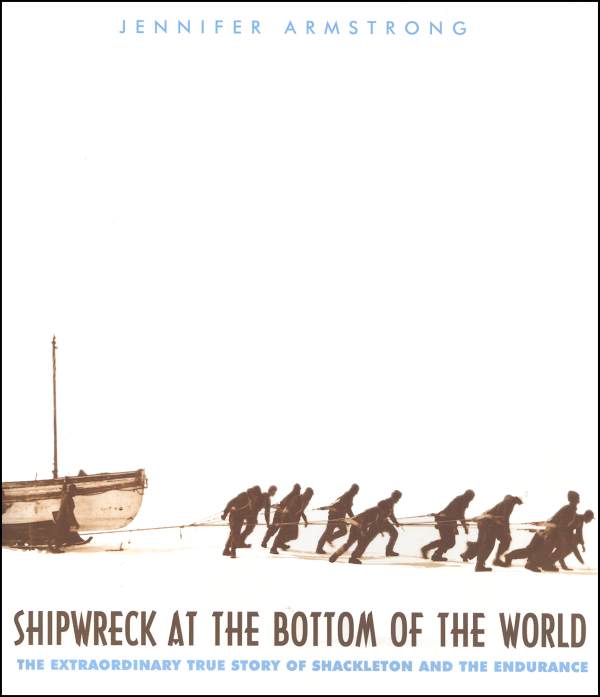
Shipwreck at the Bottom of the World by Jennifer Armstrong
This thrilling tale of survival is the account of Earnest Shackleton’s failed attempt to reach the South Pole. With his ship crushed by ice, Shackleton led his crew back to safety without losing a single man.
Team Moon by Catherine Thimmesh
This book has lots of pictures and tells how 400,000 people played a role in landing Apollo 11 on the moon. This is not just a list of facts. It has a definite story arc with a thrilling conclusion.
BPW: To wrap up, how is your book on teen male aliteracy going? What else have you been writing/publishing?
AS: Thank you for asking. My book on aliteracy is coming along well. I expect to be finished with it by spring of 2014. I have three other works in progress that I flit back and forth to. Perhaps by the time I get finished flitting they will all be finished about the same time.
Thanks again to Andy Sherrod for sharing his thoughts on teen, male aliteracy. Since I’ve gotten a bit fixated on the subject, this series will march on. Next up, look for my interview with YA author Brian Yansky, whose latest bookHomicidal Aliens and Other Disappointments (yes, it’s a boy book) is available now in hard back.