
What Spell-Checkers Don’t Catch

By Yellow Bird Editor David Aretha

Before I edit a manuscript, I always inform the author that I’ll be checking the text for spelling. “That’s something you can skip,” one author told me. “I already ran it through the spell-checker.”

Ah, yes, the infallible spell-checker, invented in the 1970s and honed to perfection over the decades by multi-billion-dollar software companies. Given that a flash drive the size of a Bic lighter can safely store ten thousand book manuscripts, surely the spell-checker is bullet-proof when it comes to recognizing all the words in the dictionary.

Well, it isn’t. For example, it didn’t catch multi-billion and bullet-proof in the previous paragraph, which should be multibillion and bulletproof.

Unfortunately, the spell-checker is about as effective as this winter’s flu virus. It catches simple words and correctly leaves misspelled ones underlined in red, but it sheepishly tiptoes out of the room whenever it comes to certain compound words.

Merriam-Webster’s Collegiate Dictionary, the word bible that most book publishers follow, loves to smash compound words together. According to this dictionary (and others), many words that we think are open compounds or hyphenated compounds are actually closed compounds. According to Merriam-Webster,boarding house—which slides through the spell-checker unscathed—is actually boardinghouse. The spell-checker will give the green light to first-hand, even though M-W spells it firsthand. When authors look at my edited manuscript, they are often surprised to see that I changed the spellings of dozens of their compound words in order to adhere to Merriam-Webster.

If you’re looking to self-publish without hiring a professional editor—or you want to appear as professional as possible when you submit your manuscript to a publisher—you should scroll through M-W and get a sense of all the smushed-together compound words. You’ll find stomachacheschoolteacher, andtransatlantic.

I have long come to the realization that I should scrutinize all hyphenated and open compound words. If I think such words have even a remote chance of being closed compounds, I drop them into the search box of www.merriam-webster.com. Very often, my hunch is correct.

Below are some surprising closed compound words, according to the publishing world’s favorite dictionary. You don’t need to memorize these spellings, but I suggest you take two minutes to study the patterns. You’ll see, for example, that counter- and -up words may not always have a hyphen, and that the spellings of waitperson and congressperson indicate that other job+person words are also closed compounds.

absentmindedness

afterburner

antiaircraft

beachcomber

bedsheet

bloodsucker

bookmobile

bullheaded

butterfingers

cheesecloth

concertgoer

congressperson

counterclockwise

counteroffensive

counterrevolution

countertop

crackerjack

crewmen

cubbyhole

deathbed

deathblow

extracurricular

farmhouse

flashlight

footlocker

freestanding

freethinker

freshwater

gearshift

ghostwriter

gumdrop

gunpowder

hairdresser

halfhearted

handcart

hardheaded

headfirst

headgear

homeowner

hotbed

icebreaker

jobholder

kindhearted

landfall

laughingstock

levelheaded

lifelong

lighthearted

longtime

makeup

matchbook

moneymaker

mouthwatering

officeholder

offshore

openhanded

otherworldly

outdistance

overabundance

overaggressive

overcompensate

overgeneralization

painkiller

pawnshop

pigheaded

pincushion

plainclothes

plaything

policyholder

praiseworthy

racecourse

racetrack

ringleader

roundabout

rumrunner

saltwater

sandblast

schoolhouse

seacoast

secondhand

shipbuilding

shorthanded

shortsighted

sledgehammer

sleepwalking

stepdaughter

stockbroker

straightforward

summertime

sundress

sunup

tagline

thundershower

townspeople

troublemaker

turnaround

underdeveloped

underemphasize

uppermost

waistline

waitperson

washtub

wavelength

weatherproof

wholehearted

windowpane

windowsill

workstation

waitperson
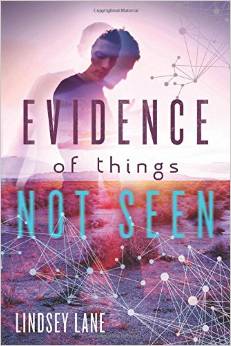
Evidence of Things Not Seen by Lindsey Lane

As soon as I read the first words of Lindsey Lane’s debut novel, Evidence of Things Not Seen, I knew. I would kill the weekend with this book. It’s a slim volume that I could have probably gotten through in a single day in editor-mode. But I was reading for pleasure. So I forced myself to take it slow, to savor.

“We leave pieces of ourselves everywhere. Every time we meet someone, they take some of us and we take some of them. That’s how it is. Little particles stick us together. Bit by bit. I think it’s how we get whole.”

That text from the first of many torn “piece[s] of notebook paper found on the side of US 281” is how Evidence of Things Not Seen opens.

I couldn’t help thinking of James Dickey’s novel Alnilam or David Lynch’s Twin Peaks as I read deeper into the secrets of the book’s small Texas town. Like those older works, Evidence is also an opaque mystery, a hunt for a missing teen that dances on the edge of fantasy. The magic in Lane’s story is powerful but shy, preferring to hide in the spaces between. And it takes the form of particle physics. That’s right, I said particle physics.

Tommy, the boy who’s disappeared, is a cherished outsider in his community, an eccentric genius the other kids at “Fred High” all look out for, even if they don’t understand him. And he’s really, really into theoretical physics, especially the idea of alternate dimensions. Many of his peers think that’s what happened to him, that he stepped into another dimension.

Peppering her story with highbrow physics is just one of the many wonderful ways Lane breaks the rules. Another is the structure. This novel could easily have been marketed as a collection of short fiction. Its a string of eyewitness accounts and standalone stories, each from a different perspective. But I came to agree with the choice to label Lane’s book a novel. It has the requisite long-form arc.

Boy does it. Evidence builds like the sound of a passing semi at night. To force the metaphor, Lane’s climax and resolution has the glare and shadow of that speeding big-rig, as well. I recognized it’s power more from the memories and associations her words invoked than from the scene she showed me. If you like neat and tidy endings, this book may frustrate you.

It’s risky for a debut novelist to break as many rules as Lane does. But she pulls it off beautifully. For example, her chapter called “The Last Dance” is essentially a short story about an elderly married couple taking a drive.

How is that YA?

It’s because the wife’s dementia has broken her bond with linear time. She mostly lives as a teen in her mind. Her clear-headed husband, who just wants to stay with her, plays along, drifting hand in hand with her back to the beginning of a long shared history. It’s poignant and tragic and joyful all at once. And somehow, it works beautifully in a book written for teens.

Even with all its iconoclasm, Evidence of Things Not Seen does strictly adhere to the one unbreakable rule of novel writing: you can do whatever you want so long as you’re good enough to pull it off. Lindsey Lane’s debut proves she is so much more than good enough.

Read Evidence of Things Not Seen. Now.

Make More of Setting: Affordances

If there is a gun over the mantel in the first act, by the end of the play it should go off. If you put something into your fictional world—especially if you draw attention to it—you should think about its affordances, and make the most of them.

If there is a gun over the mantel in the first act, by the end of the play it should go off. If you put something into your fictional world—especially if you draw attention to it—you should think about its affordances, and make the most of them.

As a writer and an editor I often find myself staring at a scene where the character is stuck in a blank space—thinking without acting. How do we get ourselves out of these habits? How do we find more potential for action?

A lot of times, I think we’re told to go back to our plot (What is the next story event? How do I make that happen?) or character (What does the protagonist want? What will she do next to try to get it?) While these are both good options, I know that sometimes they work better in theory than in practice. Sometimes I go back to my plot and my character and still surface an hour later, not sure what to actually start writing. How to start building a scene.

In this case, I’m going to recommend going back to setting.

One of the helpful terms that I’ve stolen from a psychologist friend is the idea of affordances. An affordance is the potential for action inherent in an object. A doorknob affords turning. A glass of tea affords drinking. A setting is filled with objects, and each object has many affordances—possible actions.

Look around at the setting you have created. What is there for your character to interact with? How many different possibilities are inherent in the same object? What would it show us about your character if, instead of drinking the glass of tea, he threw it at the wall? Offered it to someone he thought needed it more than he did? Used it to tell someone’s fortune?

If you’re working in a world that has different parameters than the real world (magical realism, fantasy, etc) ask yourself if anything in your setting has different affordances.

To create action, first you have to create the potential for action. How can we get the most potential from our settings? The most interesting potential? The most telling potential? The most explosive potential? The most unique potential?

The idea reminds me a bit of the Chekovian bit of wisdom that is often repeated in theater circles: If there is a gun over the mantel in the first act, by the end of the play it should go off. If you put something into your fictional world—especially if you draw attention to it—you should think about its affordances, and make the most of them. In my favorite brand of storytelling, the gun will be used by the end of the story, but not in the way we expect.

When I go back to my wandering, floating, not-quite-doing-anything character, and sketch in a few more details of the setting, things immediately start to happen. Keeping plot and character in mind, I follow these small actions to see what they can tell me, and to see where they lead.


Amy Rose Capetta is the author of Entangled (Houghton Mifflin Harcourt Kids) and its sequel Unmade (forthcoming in 2014). She holds an MFA in Writing for Children and Young Adults from Vermont College of Fine Arts. She has previously worked for the Writers’ League of Texas, and served as assistant editor for the Children’s and Young Adult section of the literary journal Hunger Mountain. In addition to her novels, she has written screenplays, the most recent of which debuted at the Toronto ReelHeart International Film Festival. After calling Austin her home for several years, Amy Rose now lives in the Midwest, where she focuses on writing and editing fiction.

Areas of Specialty: Narrative work for middle grade, young adult, and adult readerships. All genres welcome. Particular areas of interest: fantasy, sci-fi, dystopian, supernatural, genre-bending fiction, creative nonfiction, literary fiction, LGBTQ fiction.

Available For: Manuscript critiques, content editing, developmental editing, first chapter critique and edit, synopsis review and edit, private writing coaching.

Want to hire Amy Rose as your editor or writing coach? Click here!

Banish Stick-Figure Writing: How Concrete Sensory Details Make All the Difference in Fiction

Thin, generic description is the literary equivalent of drawing with stick figures. That’s a problem—because your reader’s imagination will only engage if it’s convinced what’s happening is real. And if their imagination won’t engage, their emotions won’t engage, and they’ll puts the book down and find something fun to do.

So how do you flesh your stick figures out?

In 1979, a revolutionary book called Drawing on the Right Side of the Brain pinpointed why so many adults and older children can’t draw. It’s because they aren’t drawing what they see—they’re drawing what they know.

In other words, they’re drawing a category, rather than the thing itself.

I “know” a face is oval and has two eyes, a nose, and a mouth, so that’s what I draw. Then I’m surprised that it looks like a stick figure, not a human face. In reality, depending on the way a face is angled and the way the light falls across it, a real face may not be oval, may not have two (visible) eyes, may have only part of a nose, etc.

I “know” a tree has a thick trunk and at the top some branches and leaves—so I draw a stick-figure tree instead of the wild living thing flinging out arms and fingers in front of me.

The same thing can happen in writing. “A dog stood under a tree. A girl ran past.”  But “dog,” “tree,” and “girl” aren’t descriptions; they’re labels for abstract concepts. Was it a tiny mutt or a graceful Great Dane? An aspen or a cottonwood? A 6-year-old Latina or a willowy white teenager?

A few fleshier alternatives:

  • A twenty-foot cottonwood, heart-shaped leaves turning lazily in the breeze
  • A mutt with a smashed-in boxer’s face and lolling tongue
  • A small girl with tangled dark hair, wiping her nose on a dirty coat sleeve as she runs past.

Now a little of this kind of description goes a long way. Be judicious: you don’t want to force-feed your reader a whole box of chocolates. If I were editing myself here, I’d decide which was the most important element for the reader to focus on. Let’s say it was the dog:

“The mutt stood under a tall cottonwood. He turned his smashed-in boxer’s face, tongue lolling, to watch a small, dark-haired girl run past. He did not give chase.”

We’re humans, we live in bodies. That means our minds won’t believe, our imaginations won’t be convinced, without plenty of concrete sensory details. Banish the stick figure. Make your writing juicy with life, and allow the reader to fall in love with your book.

We All Need Community: The Benefits of Critique Partners and Beta Readers

I talk myself out of editing jobs all the time. A new writer will approach me about a project. We’ll get to talking. And I’ll end up advising that writer to wait to spend money on a professional editor. I’ve blogged about this before in various ways, I suppose. And now I’m going to do it again because it bears restating. Writers are stubborn. Sometimes we need to be beaten with an idea for a bit to grok it.

These writers I talk to shouldn’t be spending money on editing yet. A lot of times their contact with me is the first they’ve had with a fellow writer. Sometimes it’s the first time they’ve shared their work at all, which is a monumental moment. They’ve figured out they can’t do the writing thing on their own like they once believed. They’re beginning to understand they need a community.

I usually tell them to seek out critique partners and/or beta readers. And if they’re not already reading in their genre, I strongly advise them to do that, too. So far I haven’t heard back from any of them. I take that as a good sign, a sign they got the deeper message: they need to build themselves a place in a writing community.

I’m talking about more than a writer’s need for critical, constructive feedback here. Or the need for mentors and compatriots, fellow writers who are discovering or have discovered how to make a go of the writing life. A writer needs a few fans, even at the beginning. Maybe it’s just one coworker who stops him in the hall to say how much he loves reading the writer’s blog. However it takes place, that kind of out of the blue validation helps build much needed self-confidence. And knowing there are people reading what you write makes it harder to justify blowing it off.

By the way, I’m deliberately leaving family out of this discussion because family is different. The people who live with writers have to buy in on a whole other level.

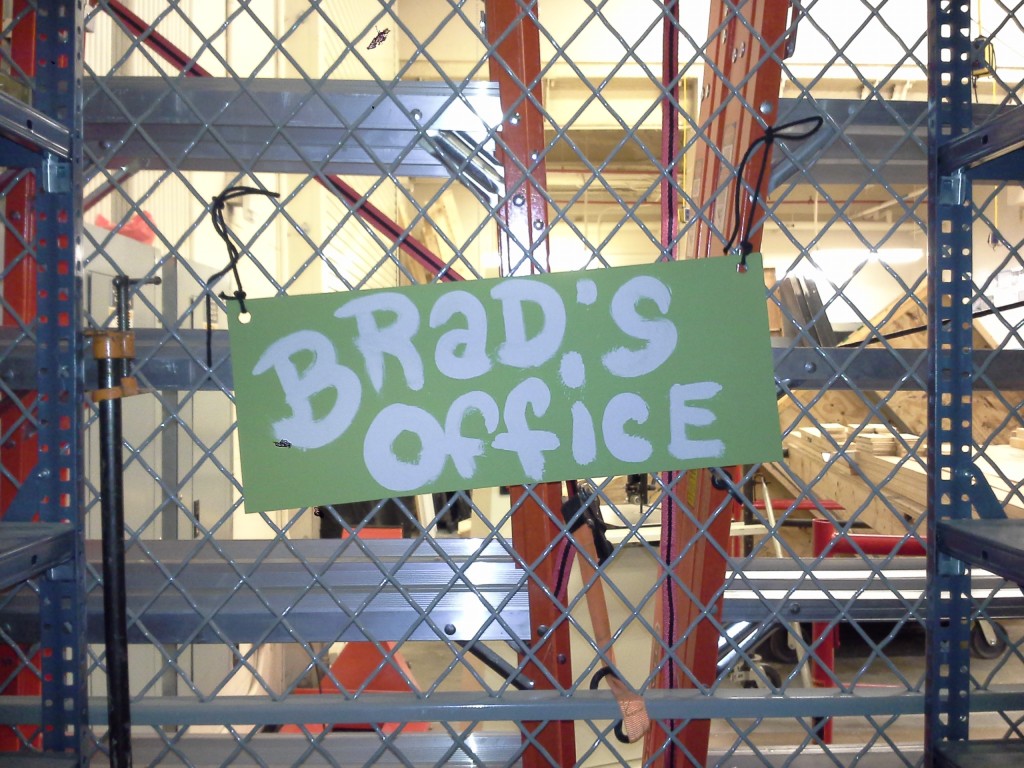
I recently had one of these quasi-fan experiences. As you may know, I’m a theater technician as well as a writer and editor. One of my day jobs is as a carpenter at the Texas State Performing Arts Center Shop. Not only do I build scenery there, I usually work on my writing and editing projects during my breaks, sitting on an air-compressor in a secluded corner of the tool cage. While I was gone on my recent vacation (if you want pictures, click here), the scenic painting professor made and installed a sign above my little space between the shelves.

She’s not a writer. As far as I know she’s never even read my writing. I’ve known her for less than a year. But she sees me in there with my computer in my lap. And she’s an artist; she understands. She gets the yen to make something as good as it can be. So she surprised me with her little sign. What I don’t think she understands is how much that small act inspires me every day, how it makes it easier to go into the noisy solitude of the tool cage and write, how she’s a big part of my writing community. I should probably tell her all that, huh?

And that’s why I talk myself out of so much editing work. There’s a lot of great things a freelance editor can offer a writer. But a hired editor can’t offer that fundamental, made-to-fit writing community every writer needs. We writers have to build that kind of support network for ourselves.